TL;DR

Turn your quiet moments into listening time
- Thousands of audiobooks, podcasts and originals
- Listen on your phone, tablet or Echo — also offline
- Cancel anytime
A crystal healing set is a curated bundle of gemstones grouped by purpose — usually seven stones for the chakras, packaged with guide cards and a pouch, priced from $15 to over $100. No peer-reviewed evidence supports healing effects beyond placebo, according to a 2001 University of London study, but many people still use them as focus tools for meditation and intention-setting. Buy ethically sourced stones, verify authenticity, and never use crystals as a substitute for medical care.
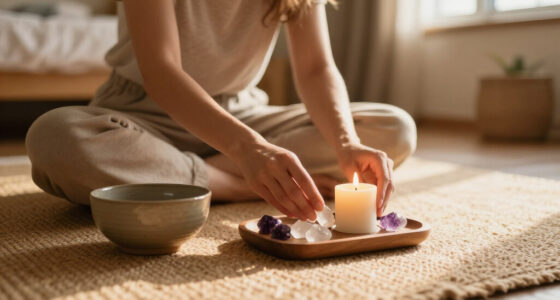
The amethyst in your hand is cool, heavy, and violet-edged — and according to its packaging, it promotes tranquility. According to science, it does something else entirely: it gives your brain a focal point. Both things can be true at once.
Crystal healing sets have exploded from niche New Age shops to Instagram feeds, subscription boxes, and gift guides. A beginner chakra set typically includes seven tumbled stones, a pouch, and a guide card — for somewhere between $15 and $80.
In this guide, you’ll learn what’s actually in these sets, what research says (spoiler: it’s placebo, and that’s worth understanding, not dismissing), how to spot fakes, and how to use a set as a genuine mindfulness tool — not a medical one.
A standard beginner set contains seven chakra stones (red jasper through amethyst) with a pouch and guide card; $15–30 is fair for tumbled stones, and anything…
Science attributes crystal effects to placebo — a 2001 University of London study found people couldn’t tell real crystals from glass — so treat sets as mindfu…
Choose your set by what you’ll do with it: tumbled stones for holding and carrying, raw for display, individual stones over themed sets if you have one specifi…
Run every claim through a two-question filter: focus/ritual claims are fair game; treatment claims ("eases depression," "boosts immunity") fail the evidence te…
Spot fakes with four checks: suspiciously low prices, perfect uniformity, air bubbles, and neon colors.
Never soak stones in drinking water — malachite is toxic when wet and cinnabar contains mercury — and keep small stones away from young children and pets.
What You Actually Get in a Crystal Healing Set
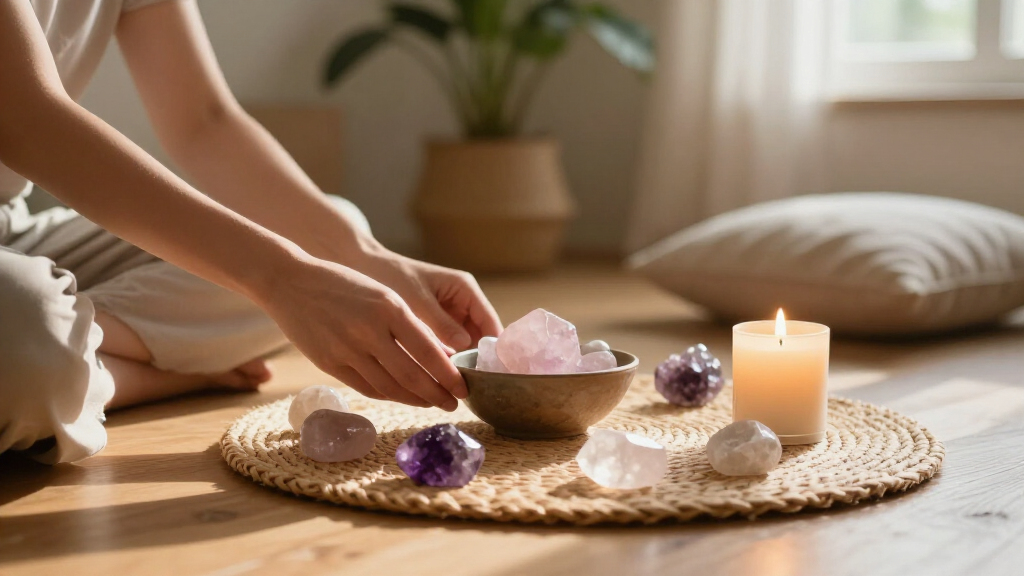
A crystal healing set is a curated collection of gemstones sold together and organized around a single purpose — usually chakra balancing, zodiac signs, or intention themes like abundance or love. Most beginner sets contain seven tumbled stones, one for each chakra, plus a small pouch and an info card explaining what each stone supposedly does.
Open a typical chakra set and you’ll find this lineup, root to crown: red jasper, carnelian, citrine, green aventurine, turquoise or clear quartz, lapis lazuli, and amethyst. Each color maps to a traditional energy center in the body — red at the base, violet at the crown.
Beyond chakra sets, you’ll run into manifestation sets (citrine, pyrite, clear quartz), protection sets (black tourmaline, obsidian, smoky quartz), and self-love sets built around rose quartz. Subscription crystal boxes have also surged recently, mailing you a few stones monthly for $20–40.
Stones come two ways: tumbled (smooth, polished, pocket-friendly) or raw (rough, unpolished, more dramatic-looking). Tumbled stones survive being dropped, carried, and sat on. Raw crystals look striking on a shelf but chip and shed.
How to choose in 60 seconds: pick your set by what you’ll actually do with it, not the theme on the box. If you plan to meditate with stones in hand, choose tumbled — they’re smooth and comfortable to hold. If you want shelf decor, raw works. Use this quick decision framework:
- New to crystals, unsure it’ll stick? Buy the budget seven-stone chakra set — it covers every common stone in one purchase.
- Have a specific goal (focus, calm, sleep)? Skip themed sets and buy two or three individual stones that match it — you’ll get better specimens for the same money.
- Giving a gift? A mid-range chakra set with a guide booklet is the safest universal choice.
- Considering a subscription box? Do the math first: at $20–40/month, you’ll exceed the cost of a complete set in two months, and you don’t control which stones arrive.
Do Crystal Healing Sets Actually Work? The Honest Answer
No peer-reviewed study has found that crystals heal anything beyond the placebo effect — and the most cited research says exactly that. In 2001, psychologist Christopher French at the University of London ran a study where participants held either real quartz crystals or glass fakes. Both groups reported the same tingling, warmth, and well-being. The crystals’ power came from belief and suggestion, not the stone [1].
Here’s the interesting part: that doesn’t make the experience fake. Placebo effects are real, measurable changes in how you feel. If holding a cool, smooth amethyst helps you slow your breathing and settle into meditation, that’s your brain doing genuine work — the stone is just the anchor.
Think of a crystal set as a ritual object, like a rosary or a meditation bell. The bell doesn’t calm you. Ringing it does, because you’ve trained your nervous system to respond.
The honest framing: crystals are a focus tool for intention and mindfulness, not a treatment. Anyone selling them as a cure — for anxiety, illness, or anything else — is overpromising. Regulators agree: the FTC has pushed back on unsubstantiated health claims by wellness brands in recent years.
So what should you do with this information? Run everything a seller or guide card tells you through a simple two-question filter. Question one: is this a focus, ritual, or intention claim? (“Helps me wind down before bed,” “A reminder of my goal.”) Those are fair — the stone is doing anchor work, and your expectations are honest. Question two: is this a treatment claim? (“Eases depression,” “Boosts immunity,” “Balances hormones.”) Those fail the evidence test every time, and any seller making them has told you something important about their honesty. If you catch yourself believing a treatment claim, that’s your cue to put the stone down and book the doctor’s appointment instead.
If you’re dealing with anxiety, depression, or physical illness, crystals can sit alongside real care — never in place of it.
How to Spot Fake Crystals Before You Waste $60
Dyed, synthetic, and mislabeled stones flood the online crystal market, so a few quick checks can save you real money. The most common fakes are dyed howlite sold as turquoise, glass sold as clear quartz, and lab-grown amethyst passed off as natural.
- Check the price. A large “natural” amethyst geode for $15 is almost certainly too good. Real specimens carry real costs.
- Look for imperfections. Natural crystals have inclusions, cloudy patches, and uneven color. Glass-perfect uniformity is a red flag.
- Do the scratch test. Real quartz scratches glass. Glass imitations won’t.
- Watch for bubble traps. Tiny air bubbles inside mean glass or resin, not crystal.
- Be suspicious of neon colors. Vivid magenta or bright blue “crystals” at budget prices are usually dyed.
Buy from sellers who name the sourcing region — Madagascar, Brazil, and China are the big ones — and who answer questions about mine conditions without dodging. A seller who can’t tell you where a stone came from often doesn’t know what it is either.
Ethical sourcing matters too. Mining conditions and labor practices in the crystal trade are genuinely murky, and demand for traceable, ethically sourced crystals has pushed better sellers to document their supply chains. Reward the ones who do.
What a Fair Price Looks Like (and What to Skip)
A fair price for a starter crystal set is $15–30 for a budget seven-stone chakra set, $30–80 for mid-range sets with better specimens and real guide materials, and $100+ for premium sets with large or rare pieces. Below $15, expect dyed stones and vague labels.
| Price Tier | What You Get | Best For |
|---|---|---|
| Budget ($15–30) | 7 tumbled stones, pouch, basic card | Curious first-timers |
| Mid-range ($30–80) | Verified stones, guide booklet, sometimes raw pieces | Regular meditation practice |
| Premium ($100+) | Large specimens, rare stones, detailed sourcing info | Collectors and gifts |
Skip sets that make medical claims on the packaging — “heals,” “cures,” “treats” — because that’s both a legal gray zone and a sign the seller values marketing over honesty. Also skip mystery boxes if you want specific stones; you’ll end up with duplicates you don’t need.
How to Actually Use Your Set (5 Minutes, No Incense Required)
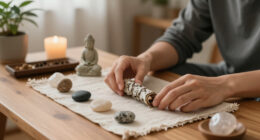
The simplest way to use a crystal healing set is as a meditation anchor: pick a stone, hold it, and focus on its weight and temperature while you breathe. That’s it — no special ritual needed, though many people build one anyway because ritual itself helps them show up.
A realistic first week might look like this. Monday morning: choose amethyst, sit for five minutes, notice the stone’s cool surface warming in your palm. When your mind wanders, the stone is what you return to — a physical object pulling you back, like a knot in a string. By Friday, picking up that stone triggers a small Pavlovian calm.
- Meditation: hold one stone, or lay chakra stones along your body while lying down
- Carrying: keep a tumbled stone in your pocket as a tactile reminder of an intention
- Placement: keep one on your desk as a focus object during work
For care: cleanse stones with moonlight, sound, or smoke if that’s part of your practice — it’s a nice reset ritual. Two real warnings, though: selenite dissolves in water, and some stones fade in direct sunlight. This is physics, not belief.
Safety First: The Three Rules Nobody Puts on the Card
Crystal sets are safe for adults with basic precautions, but three rules matter. Keep small stones away from children under five — tumbled stones are exactly the size of a swallowing hazard. Keep them away from pets for the same reason.
Rule two: never make gemstone “elixirs” by soaking stones in drinking water. Malachite is toxic when wet, and cinnabar contains mercury. Even safe-looking stones can leach minerals or dye. Those crystal-infused water bottles trending on social media? Only use ones with a separate chamber that keeps the stone out of the water.
Rule three, the big one: crystals are never a substitute for medical care. No study supports that use, and delaying real treatment for any condition — physical or mental — carries real risk. Use your set for calm, focus, and ritual. Use a doctor for health.
Frequently Asked Questions
Do crystal healing sets actually work?
Not in the medical sense — no peer-reviewed research shows healing effects beyond placebo. A 2001 University of London study found participants reported identical sensations from real crystals and glass fakes. However, many people genuinely benefit from crystals as meditation anchors and ritual objects, which is a real psychological effect worth using.
Which crystal set is best for beginners?
A seven-stone chakra set in the $15–30 range is the standard starting point — it covers the most common stones, comes with a guide card, and costs little enough that you’re not invested if the hobby doesn’t stick. Look for tumbled stones (durable and pocket-safe) and a seller who names where the stones were sourced.
How do I know if the crystals in my set are real?
Check four things: price (too cheap means fake), imperfections (natural stones have cloudy patches and inclusions), air bubbles (a sign of glass or resin), and color (neon hues usually mean dye). Real quartz will also scratch glass. When in doubt, buy from sellers who document their sourcing from regions like Madagascar or Brazil.
How do I cleanse and charge my crystals?
Common methods include moonlight, smoke, and sound — pick whichever fits your routine. Avoid two things: water on selenite (it dissolves) and prolonged direct sunlight on amethyst or rose quartz (they fade). Cleansing is best understood as a reset ritual that reinforces your practice, not a physical necessity.
Are crystal sets safe around kids and pets?
Keep them away from small children and pets — tumbled stones are a choking hazard. Also never soak stones in drinking water: malachite is toxic when wet and cinnabar contains mercury. If you use a crystal water bottle, only choose one with a separate chamber that keeps the stone out of the water entirely.
Conclusion
Buy your crystal healing set with open eyes: a fair price, verified stones, honest expectations, and a doctor for anything medical. Held that way, a small amethyst becomes what it’s actually good at — a smooth, cool anchor that pulls your scattered attention back to the present moment, one breath at a time.
The stone doesn’t do the work. You do. But there’s nothing wrong with keeping something beautiful in your pocket while you do it.
Halloween Picks
halloween
As an affiliate, we earn on qualifying purchases.