
TL;DR

Get books, candles and calm essentials delivered free — and shop member deals
- Fast, free delivery on millions of items
- Access to Prime Big Deal Days deals on October 6–7
- Prime Video, Amazon Music and more included
A lost ancient Greek philosophical treatise, burned in the 79 AD eruption of Mount Vesuvius, has been fully deciphered through advanced AI and X-ray imaging. This breakthrough offers new insights into Stoic philosophy and ancient debates on ethics.
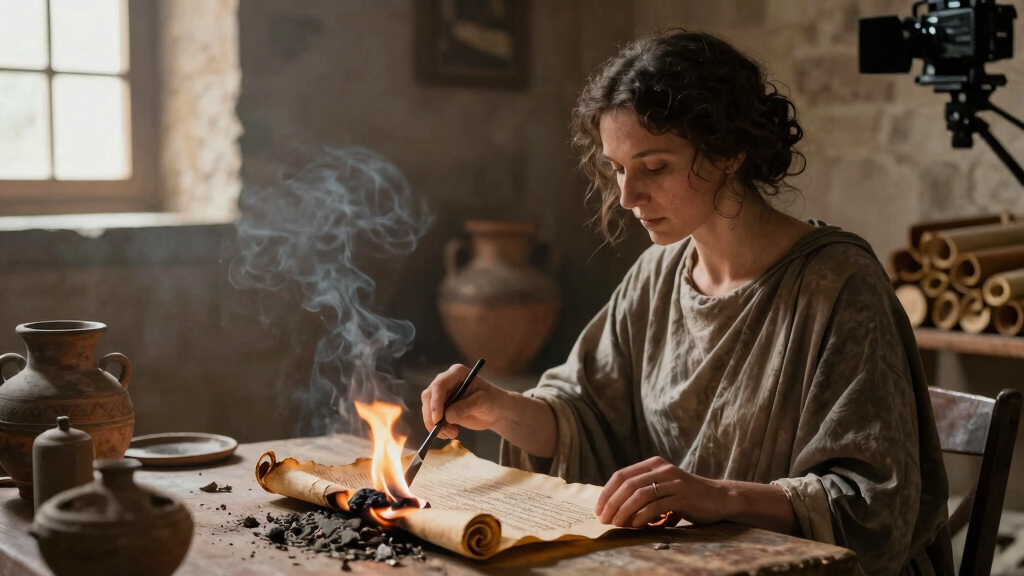
Researchers have fully decoded a scroll burned in the eruption of Mount Vesuvius in 79 AD, revealing an ancient Greek philosophical treatise on ethics attributed to a Stoic thinker from the second century BC. This breakthrough was achieved through the combined use of AI and X-ray microtomography, allowing scholars to read the scroll without physically unrolling it, which was previously impossible due to its damage.
The scroll, known as PHerc. 1667, was part of the Villa of the Papyri collection and is now the first Herculaneum papyrus to be fully digitally unrolled and studied. It appears to be a philosophical work focused on human nature, impulse, and moral progress, and mentions Aristocrates, a disciple of Chrysippus, suggesting a date in the second century BC. The decoding was made possible by recent technological advances and the Vesuvius Challenge, a contest promoting the digital preservation of ancient texts.
In addition to PHerc. 1667, scholars are working on other texts from the same collection, including PHerc. 139, identified as a work by Epicurean philosopher Philodemus on the gods. These texts, long thought lost or inaccessible, offer new opportunities to understand ancient philosophical debates, especially between Stoics and Epicureans. The digital decoding process preserves the integrity of fragile artifacts and opens new avenues for scholarship without physical handling.
Implications for Understanding Ancient Philosophy
This discovery significantly advances the study of ancient Greek philosophy by providing direct access to texts previously thought lost forever. It offers new insights into Stoic ethics, human nature, and the debates that shaped classical philosophical thought. The ability to read burned and damaged scrolls through digital means could revolutionize the preservation and study of other ancient manuscripts, potentially rewriting parts of history and philosophy.
Furthermore, this breakthrough demonstrates the potential of AI and imaging technologies in cultural heritage preservation, setting a precedent for future discoveries and scholarly work. It underscores the importance of technological innovation in unlocking the past and expanding our understanding of human intellectual history.
As an affiliate, we earn on qualifying purchases.
Vesuvius Eruption and the Villa of the Papyri
The eruption of Mount Vesuvius in 79 AD buried the Roman city of Pompeii and nearby villas, including the Villa of the Papyri, which housed a vast library of scrolls, many of which were written by Greek and Roman philosophers. Over centuries, these scrolls suffered physical damage, with many considered lost or unreadable. The Villa’s collection included works from Epicurean, Stoic, and other philosophical schools, providing a unique window into ancient debates.
Until now, most of these texts remained inaccessible due to their fragile state. Recent technological advances, including X-ray microtomography and artificial intelligence, have enabled scholars to virtually unroll and decipher these scrolls. The first successful full reading of PHerc. 1667 marks a milestone in this ongoing effort, opening new possibilities for recovering lost knowledge from the ancient world.
“This is a historic moment; we can now access texts that were thought to be forever lost, thanks to digital and AI technologies.”
— an anonymous researcher
As an affiliate, we earn on qualifying purchases.
Remaining Questions About the Scrolls and Their Content
While PHerc. 1667 has been fully decoded, the full extent of its content and its precise authorship remain under scholarly review. It is not yet clear how representative this work is of the broader collection or how it connects to other texts yet to be deciphered. Additionally, interpretations of the philosophical arguments within are still preliminary, pending further analysis.
ancient scroll preservation technology
As an affiliate, we earn on qualifying purchases.
As an affiliate, we earn on qualifying purchases.
Future Deciphering and Scholarly Analysis of Vesuvius Texts
Scholars plan to continue applying advanced imaging and AI techniques to other damaged scrolls from the Villa of the Papyri. The goal is to decode additional texts, particularly those related to Epicurean philosophy, and to contextualize the newly recovered works within ancient philosophical debates. Further research may also refine dating and authorship, deepening understanding of the intellectual landscape of the second century BC.
digital unrolling of ancient manuscripts
As an affiliate, we earn on qualifying purchases.
As an affiliate, we earn on qualifying purchases.
Key Questions
What is the significance of this discovery?
This is the first full digital unrolling and reading of a scroll burned in Vesuvius’s eruption, opening new pathways for studying lost ancient texts and understanding early Greek philosophy.
How was the scroll decoded without physically unrolling it?
Researchers used X-ray microtomography combined with AI algorithms to create a digital reconstruction of the scroll’s contents, preserving its fragile state while revealing its text.
What kind of philosophy does the scroll contain?
The scroll appears to be a Stoic treatise on ethics, human nature, and moral progress, dating to the second century BC.
Are there other texts from the Villa of the Papyri being studied?
Yes, scholars are working on additional scrolls, including works by Epicurean philosophers like Philodemus, aiming to recover more lost texts and debates.
When will more texts be available for study?
Deciphering is ongoing, with further technological advances expected to enable the reading of more scrolls in the coming years.
Source: The best free cultural & educational media on the web – Open Culture
Halloween Picks
halloween
As an affiliate, we earn on qualifying purchases.