Meditation smart speakers can make guided sessions, breathing timers, and sleep sounds easier to bring into a daily routine. I rank the Amazon Echo Dot (5th Gen) as the best overall balance of voice access, compact size, and everyday usefulness; the Echo Spot stands out for bedside routines, while the Sonos Era 100 suits listeners who put fuller sound first. The main tradeoffs are audio quality versus footprint, screen-based convenience versus a distraction-free setup, and smart features versus setup simplicity. No speaker replaces a dedicated meditation app or practice, so compatibility and subscription needs matter. Read on for the full breakdown and help matching a speaker to your space and routine.

Turn your quiet moments into listening time
- Thousands of audiobooks, podcasts and originals
- Listen on your phone, tablet or Echo — also offline
- Cancel anytime
Key Takeaways
- The Echo Dot (5th Gen) leads as the all-rounder because it pairs a small footprint and voice control with the flexibility to support varied daily routines.
- The Echo Spot is the clearest bedside pick for buyers who want an at-a-glance clock and sleep sounds, though its display may be unwelcome in a screen-free meditation space.
- The Sonos Era 100 prioritizes listening quality over compactness and basic smart-speaker value, making it a better fit for a dedicated room than a tight bedside table.
- Smart-home features vary more than meditation features: the newer Echo Dot models add hub and assistant capabilities, but those extras matter only if they fit the buyer’s existing ecosystem.
- The Google Nest Mini and smaller Echo options favor simplicity and space-saving, while larger or more feature-rich models make more sense when sound, display, or connected-home control is a priority.
| Amazon Echo Dot (5th Gen) Smart Speaker, Charcoal |  | Best Overall for Alexa-Led Meditation | Generation: 5th Gen | Dimensions: 3.9 x 3.9 x 3.5 in | Weight: 10.7 oz | VIEW LATEST PRICE | See Our Full Breakdown |
| Google Nest Mini 2nd Generation Smart Speaker – Charcoal |  | Best Compact Google Assistant Pick | Color: Charcoal | Dimensions: 4.0 x 4.0 in | Weight: 1.6 lb | VIEW LATEST PRICE | See Our Full Breakdown |
| Gemini Home Speaker with AI Assistant, Clock, and Sleep Sounds (BRS-180), Black |  | Best for Built-In Sleep Sounds | Model: BRS-180 | Sleep sounds: 16 built-in | Clock display: 12-hour, auto-syncing, with three brightness settings | VIEW LATEST PRICE | See Our Full Breakdown |
| Echo Spot Smart Alarm Clock with Alexa, Glacier White | 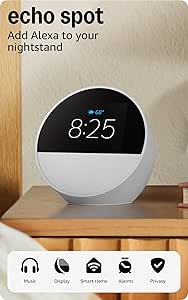 | Best for a Screen-Based Bedside Routine | Dimensions: 4.5 x 4.1 x 4.4 in | Weight: 14.3 oz | Display: 2.83-inch touchscreen, 240 x 320 pixels | VIEW LATEST PRICE | See Our Full Breakdown |
| Amazon Echo Dot Max Smart Speaker with Alexa, Graphite |  | Best Premium Sound and Smart-Home Hub | Dimensions: 4.27 x 4.27 x 3.9 in | Weight: 17.82 oz | Drivers: 0.8-inch tweeter and 2.5-inch woofer | VIEW LATEST PRICE | See Our Full Breakdown |
| Amazon Echo Dot (Newest Model) – Smart Speaker with Alexa+ and Smart Home Hub, Graphite |  | Best for Smart-Home Meditation Routines | Color: Graphite | Model: Newest Echo Dot | Voice assistant: Alexa+ | VIEW LATEST PRICE | See Our Full Breakdown |
| Sonos Era 100 Smart Speaker – Black |  | Best for Rich, Room-Filling Meditation Audio | Color: Black | Connectivity: Wi-Fi, Bluetooth, 3.5 mm line-in | Voice assistant: Amazon Alexa | VIEW LATEST PRICE | See Our Full Breakdown |
| meditation smart speaker | Dimensions | Weight |
|---|---|---|
| Amazon Echo Dot | 3.9 x 3.9 x 3.5 in | 10.7 oz |
| Google Nest Mini 2nd Generatio | 4.0 x 4.0 in | 1.6 lb |
| Gemini Home Speaker with AI As | — | — |
| Echo Spot Smart Alarm Clock wi | 4.5 x 4.1 x 4.4 in | 14.3 oz |
| Amazon Echo Dot Max Smart Spea | 4.27 x 4.27 x 3.9 in | 17.82 oz |
| Amazon Echo Dot | — | — |
| Sonos Era 100 Smart Speaker | 7 in D × 5.1 in W × 7.22 in H | 2020 g |
More Details on Our Top Picks
Amazon Echo Dot (5th Gen) Smart Speaker, Charcoal
I’d choose the Echo Dot (5th Gen) when meditation means asking Alexa to start a session, play a podcast, or run a bedtime routine from one compact speaker. Its Wi-Fi and Bluetooth playback give it more flexibility than the Gemini Home Speaker, whose assistant access depends on a paired device. Motion and temperature sensors can also trigger compatible routines, useful for automating a quiet evening setup beyond audio alone.
The tradeoff is its mono, single-driver sound: it works for spoken guidance and ambient tracks, but buyers seeking fuller room-filling playback should compare it with the Echo Dot Max. Smart-home extras add value only if they fit your setup; eero extension requires a compatible eero network. I’d also skip it if your meditation needs include ad-hoc Wi-Fi, which it does not support.
Pros:- Plays music, audiobooks, and podcasts over Wi-Fi or Bluetooth.
- Motion and temperature sensors can support compatible routines.
- Works with compatible Echo devices or Fire TV for multi-room audio or home theater.
- Includes a microphone-off button and other privacy controls.
Cons:- Mono playback from one 1.6-inch full-range driver is less expansive than the Echo Dot Max’s two-way design.
- eero Built-in requires a compatible eero router, account linking, and app setup.
- Does not support ad-hoc Wi-Fi networks.
Best for: Alexa users who want guided meditation, podcasts, and simple smart-home routines from a compact bedside or living-room speaker.
Not ideal for: Listeners who prioritize rich, room-filling meditation audio or need ad-hoc Wi-Fi support.
- Generation:5th Gen
- Dimensions:3.9 x 3.9 x 3.5 in
- Weight:10.7 oz
- Speaker:1.6-inch full-range driver; mono
- Audio bandwidth:62 Hz–19 kHz at volume 6
- Wi-Fi:Dual-band 802.11a/b/g/n/ac, 2.4 and 5 GHz
- Smart home compatibility:Wi-Fi, Bluetooth Low Energy Mesh, and Matter
- Privacy:Microphone-off button and multiple privacy controls
Our verdict“Choose the Echo Dot if you want flexible Alexa-led meditation and routines in a small speaker, not the fullest sound in this group.”
Google Nest Mini 2nd Generation Smart Speaker – Charcoal
The Google Nest Mini 2nd Generation suits a meditation corner where space is tight and Google Assistant is already part of the household. Its compact tabletop design is easier to tuck beside a bed or on a small shelf than the larger Echo Dot Max, while the product description points to richer bass than its predecessor. That makes it a practical voice-controlled option for spoken sessions and gentle background audio without a prominent device taking over the room.
Its limitations are more noticeable beside the Echo Dot (5th Gen): the supplied connectivity details list Bluetooth but do not specify native Wi-Fi, and it needs constant wall power. I’d verify the connection and service features you rely on before buying. With no water resistance, it is also a poor choice for a sink-side meditation spot or a humid bathroom.
Pros:- Compact footprint fits easily on shelves and nightstands.
- Described as having richer bass than the previous generation.
- Supports multiple languages.
- Universal power adapter supports international use.
Cons:- Requires a wall outlet, so it is not suited to portable meditation sessions.
- Not water resistant.
- The provided product details list Bluetooth but do not specify native Wi-Fi connectivity.
Best for: Google Assistant users who want a small, always-plugged-in speaker for guided sessions in a bedroom, office, or meditation nook.
Not ideal for: People who need a battery-powered speaker, verified Wi-Fi features, or a water-resistant device for bathroom use.
- Color:Charcoal
- Dimensions:4.0 x 4.0 in
- Weight:1.6 lb
- Connectivity:Bluetooth
- Power source:Corded electric
- Mounting type:Tabletop
- Audio channels:2
- Water resistance:Not water resistant
Our verdict“Pick the Nest Mini for a compact Google Assistant setup, but choose the Echo Dot (5th Gen) if Wi-Fi playback details and sensor-driven routines matter more.”
Gemini Home Speaker with AI Assistant, Clock, and Sleep Sounds (BRS-180), Black
For a bedside wind-down routine without relying on a separate streaming service, I’d look at the Gemini Home Speaker BRS-180. Its 16 built-in sleep sounds, sleep timer, clock, and RGB night light make it more purpose-built for bedtime than the Echo Dot (5th Gen), which centers on Alexa, streaming, and smart-home routines. The dimmable display can be turned off, so it can serve as a sound machine without keeping a bright clock in view.
The main compromise is that this is not a fully independent smart speaker: voice assistant access depends on a paired device, and Bluetooth range is listed as 33 feet. Its battery provides up to six hours of wireless playback, but that is less suited to extended unplugged use than a speaker designed primarily for a fixed location. I’d choose it for sleep sounds, not for broad voice-controlled home automation.
Pros:- Includes 16 built-in sleep sounds and a sleep timer.
- Combines sound playback, clock, and RGB night light in one device.
- Clock has three brightness settings and can be turned off.
- Runs on USB-C power or its rechargeable battery.
Cons:- Assistant access depends on a paired device rather than operating as a standalone voice assistant.
- Wireless playback lasts up to six hours.
- Not water resistant.
Best for: Bedside listeners who want built-in sleep sounds, a timer, a dimmable clock, and a night light in one compact device.
Not ideal for: Buyers seeking a standalone Alexa or Google smart speaker, extensive smart-home control, or long battery-powered sessions.
- Model:BRS-180
- Sleep sounds:16 built-in
- Clock display:12-hour, auto-syncing, with three brightness settings
- Night light:RGB modes
- Connectivity:Bluetooth; 33-foot range
- Battery life:Up to 6 hours of wireless playback
- Power input:USB-C, 5 V
- Dimensions and weight:3.94 x 3.94 x 2.26 in; 10 oz
Our verdict“Choose the Gemini BRS-180 if built-in sleep sounds and bedside lighting matter more than the standalone assistant features of the Echo Dot.”
Echo Spot Smart Alarm Clock with Alexa, Glacier White
The Echo Spot is the better fit when meditation is part of a visible bedside routine: its 2.83-inch touch screen can show a customizable clock face, while Alexa handles voice requests and compatible smart-home controls. Compared with the Echo Dot (5th Gen), the Spot gives you a display for checking the time or interacting at a glance; compared with the Gemini BRS-180, it relies more on Alexa and less on built-in sleep-sound features.
Its full-range 1.73-inch speaker is designed for clear vocals and richer sound, but the compact clock format still makes it less suited to listeners who want room-filling audio. The screen may also be unwelcome if you prefer a completely dark sleep space, even with its customizable display. eero extension depends on a compatible router, and some services or skills may require subscriptions.
Pros:- Customizable 2.83-inch touch screen provides a visible bedside clock and controls.
- Alexa voice control supports routines and compatible smart-home devices.
- Full-range speaker is designed for clear vocals and deeper bass.
- Includes a microphone-off button and other privacy controls.
Cons:- The display may not suit people who want a completely dark bedroom.
- eero Built-in requires a compatible eero router for Wi-Fi extension.
- Some skills and services may require a subscription.
Best for: Alexa households that want a bedside clock with a touch display, voice-controlled routines, and a speaker for guided meditation.
Not ideal for: Minimalist sleepers who want no illuminated display, or listeners prioritizing built-in sleep sounds and battery-powered use.
- Dimensions:4.5 x 4.1 x 4.4 in
- Weight:14.3 oz
- Display:2.83-inch touchscreen, 240 x 320 pixels
- Camera:No camera
- Wi-Fi:Dual-band 802.11a/b/g/n/ac
- Speaker:1.73-inch full-range speaker
- Bluetooth:A2DP and AVRCP support
- Materials:36% recycled materials
Our verdict“Choose the Echo Spot if you want Alexa meditation controls and a bedside display, rather than the screen-free simplicity of the Echo Dot.”
Amazon Echo Dot Max Smart Speaker with Alexa, Graphite
If meditation audio is a regular part of a shared or larger room, I’d put the Echo Dot Max ahead of the Echo Dot (5th Gen) for its two-way driver design, room adaptation, and nearly twice the bass cited in the product description. That fuller presentation can make ambient tracks feel more substantial while keeping guided voices clear. Its Zigbee, Matter, and Thread hub also gives it a broader smart-home role than the simpler Echo Dot, with presence and temperature sensing available for routines.
Those extras make it a stronger all-around home audio and automation choice, but not necessarily the best bedside buy: it is larger and heavier than the Gemini BRS-180, which adds built-in sleep sounds and a clock. The Max is still two-way mono, and its eero extension requires a compatible eero network. I’d pick it for sound and device control, not portability or stereo separation.
Pros:- Automatic room adaptation adjusts playback to the space.
- Two-way design with a woofer and tweeter supports fuller audio than the Echo Dot (5th Gen).
- Built-in hub supports Zigbee, Matter, and Thread devices.
- Presence, temperature, and ambient-light sensors support compatible routines.
Cons:- Larger and heavier than the Echo Dot (5th Gen) and Gemini BRS-180.
- Two-way mono playback does not provide stereo separation.
- eero Built-in requires a compatible eero router, account linking, and setup in the eero app.
Best for: Alexa users who want fuller meditation playback in a shared room and a speaker that can act as a hub for compatible smart-home devices.
Not ideal for: Buyers who need a lightweight portable sleep speaker, built-in sound-machine features, or stereo playback from one device.
- Dimensions:4.27 x 4.27 x 3.9 in
- Weight:17.82 oz
- Drivers:0.8-inch tweeter and 2.5-inch woofer
- Playback channels:Two-way mono
- Audio bandwidth:53 Hz–16 kHz at volume 6
- Audio processing:Lossless High Definition and automatic room adaptation
- Wi-Fi:Wi-Fi 6E
- Smart-home hub:Zigbee, Matter, and Thread Border Router
Our verdict“Choose the Echo Dot Max if richer room-adapted sound and a broad smart-home hub matter more than compact size or dedicated sleep-machine features.”
Amazon Echo Dot (Newest Model) – Smart Speaker with Alexa+ and Smart Home Hub, Graphite
For meditation routines built around voice control, the newest Echo Dot pairs Alexa+ with a built-in smart home hub, so a spoken request can start music and adjust compatible devices without reaching for a phone. Its compact size suits a bedside table or small office, while the reported 1.5x increase in bass over previous models gives guided sessions and ambient tracks more weight than a tiny speaker might suggest. Compared with the Echo Dot (5th Gen), this model adds the hub and eero Wi-Fi extension, making it a better fit for connected rooms. The tradeoff is that full Alexa+ features require Prime membership, and stereo listening requires a second device. I’d choose it for practical routines, not room-filling sound.
Pros:- Compact footprint fits bedside tables, apartments, and desks.
- Built-in smart home hub supports many compatible devices.
- Increased bass compared with previous models can add body to meditation audio.
- Built-in eero technology can extend Wi-Fi coverage.
Cons:- Full Alexa+ features require a Prime membership.
- Stereo sound requires pairing with a second device.
- Its small-speaker format is less suited to listeners prioritizing expansive, detailed sound.
Best for: People who want to start meditation audio and control compatible smart-home devices by voice from a bedroom or home office.
Not ideal for: Listeners who want full Alexa+ features without Prime membership, stereo from one speaker, or a more music-focused system.
- Color:Graphite
- Model:Newest Echo Dot
- Voice assistant:Alexa+
- Smart home hub:Built-in
- Wi-Fi extension:eero built-in
- Privacy feature:Microphone enable/disable button
- Audio enhancement:1.5x the bass of previous models
Our verdict“Choose this Echo Dot for voice-led meditation and smart-home routines in a compact room, provided its Alexa+ membership requirement works for you.”
Sonos Era 100 Smart Speaker – Black
The Sonos Era 100 is the sound-first pick here: its dual-tweeter design and larger midwoofer are aimed at detailed stereo presentation and deeper bass, which can make nature recordings and guided sessions feel fuller than they do on compact options such as the newest Echo Dot. Trueplay tuning adjusts the EQ for room acoustics, a useful feature when a speaker moves between rooms or sits in a space with tricky placement. Wi-Fi, Bluetooth, and an auxiliary input provide more playback flexibility than a voice-first speaker, though the line-in connection needs a separate adapter. Alexa voice control supports hands-free playback, but the Era 100 is not water resistant, so I would keep it away from damp bathroom settings. Its strengths suit focused listening more than portability.
Pros:- Dual-tweeter architecture and a larger midwoofer target detailed stereo sound with deep bass.
- Trueplay tuning adjusts EQ to the room’s acoustics.
- Wi-Fi, Bluetooth, and auxiliary input support varied playback sources.
- Built-in Alexa enables hands-free voice control.
Cons:- Not water resistant, limiting placement in wet areas.
- Auxiliary line-in requires a separate adapter.
- At 2020 g, it is less convenient to move around than lighter compact speakers.
Best for: Listeners who want detailed, fuller meditation audio in a living room, bedroom, or dedicated practice space and value multiple streaming connections.
Not ideal for: People seeking a bathroom speaker, a battery-first portable option, or auxiliary playback without buying a separate adapter.
- Color:Black
- Connectivity:Wi-Fi, Bluetooth, 3.5 mm line-in
- Voice assistant:Amazon Alexa
- Dimensions:7 in D × 5.1 in W × 7.22 in H
- Weight:2020 g
- Enclosure material:Polycarbonate (PC)
- Water resistance:Not water resistant
- Warranty:1-year limited
Our verdict“Pick the Era 100 if sound quality and room-tuned playback matter more than water resistance, easy line-in, or lightweight portability.”
How We Picked
I ranked these speakers around the needs of a meditation routine rather than treating them as interchangeable audio devices. My main criteria were how easily a buyer can start audio or a timer by voice, whether the speaker suits a bedside or practice space, how its sound and physical design fit that setting, and what extra setup or ecosystem commitments it brings. I also weighed the everyday usefulness of alarms, sleep sounds, assistant features, and smart-home support, since a device that serves more than one routine may be easier to keep within reach.
The Echo Dot (5th Gen) takes the lead as a broadly useful, compact choice. I placed models with more focused strengths—such as the Echo Spot’s clock display or the Era 100’s sound-first role—for buyers whose needs justify their tradeoffs. The Nest Mini and more feature-heavy Echo models rank by how well their specific platform, controls, and extras suit a meditation setup, not by feature count alone. Since meditation content availability can depend on apps, services, and account settings, I treat that compatibility as a buyer check rather than assuming every speaker includes the same library.
Factors to Consider When Choosing Meditation Smart Speakers
A speaker can make a routine easier to begin, but the right choice depends on where you listen, how you access content, and what you want the device to do outside meditation. I’d settle those points before comparing assistant features or sound claims.
Match the Speaker to the Room and Routine
Start with the place where the speaker will live, not the number of features on its box. A bedside device can make a short breathing exercise or wind-down sound easy to start, while a speaker in a larger practice room may need to fill more space evenly. Think about whether you meditate seated near the device or listen from across the room, since placement affects both audibility and how often voice commands work smoothly. A display can help with clocks and timers but may add light and visual distraction during quiet practice. Avoid buying a larger speaker for a small nightstand simply because its audio is more capable. Choose the smallest form that comfortably serves your listening distance and other daily tasks.
Check How You’ll Access Guided Sessions
“Smart speaker” does not mean every meditation app or audio service works in the same way on every assistant. Before choosing, check whether your preferred service supports voice playback, casting, Bluetooth, or another reliable route on the platform you plan to use. A service that requires phone setup each time can add friction, even if the speaker itself responds quickly to voice commands. Also check whether the content you want is included with your existing account or requires a separate subscription. Buyers who mainly use recorded sessions may value dependable playback controls more than a long list of built-in sounds. If you switch between providers, favor a setup that gives you a fallback connection method.
Decide Whether a Screen Helps or Hurts
A clock or display can make a speaker more useful for bedtime, alarms, and timers, but it changes the feel of a meditation space. Consider whether you want to see the time or session status without reaching for a phone, or whether any glowing screen will pull your attention away. Screen brightness, placement, and the option to dim or disable visuals deserve attention before buying a bedside model. A display is most helpful when the speaker also serves as a clock; it is less compelling if you plan to keep the device in a dedicated quiet corner. Don’t treat visual controls as automatically easier than voice commands, especially when you want to start a session without interacting with a screen. Pick the format that supports the kind of calm you’re trying to build.
Choose Audio for the Content You Actually Play
Guided speech, soft ambient tracks, and music place different demands on a speaker. Clear voices matter when an instructor’s pacing is central, while broader room sound may matter more for music or environmental audio. Consider the room size and whether you listen close up or want sound distributed across a space. Bigger or more capable audio does not automatically make a meditation session better; it may simply take up more room or cost more in ecosystem commitment. If you use headphones for most sessions, paying extra for room-filling playback may bring little benefit. Match audio capability to your regular listening rather than an occasional use case.
Treat Assistant and Smart-Home Features as Optional
Voice assistants can reduce small barriers: starting a timer, setting a bedtime alarm, or launching familiar audio without handling a phone. Smart-home hubs and newer assistant features can add value when they fit devices you already own, but they can also make setup and privacy choices more involved. Check compatibility with your existing home platform before paying for control features you may not use. Think about where the speaker’s microphone sits and whether you want voice activation available during quiet periods; mute controls and routines can shape that experience. A simple speaker may be the better meditation tool if you want fewer connected functions. Prioritize features that make practice easier to repeat, not features that merely expand the device’s role.
Plan for Privacy, Power, and Nighttime Use
Meditation speakers often stay in bedrooms or personal spaces, so microphone controls and account settings deserve a place in the decision. Review how to mute the microphone, manage voice history, and limit unwanted notifications before settling on a model. Most smart speakers need a constant power connection, which affects where they can sit and whether a cable will cross a walkway or bedside surface. If you rely on sleep sounds, check how playback stops and whether alarms or notifications could interrupt the routine. Consider whether the speaker’s lights, spoken responses, or assistant prompts can be adjusted for nighttime use. These details rarely appear in a short feature list, yet they can determine whether the speaker feels welcome in a quiet space.
Frequently Asked Questions
Do I need a paid meditation app to use one of these speakers?
Not always, but access depends on the audio service and assistant you choose. Some listeners can play free audio or use content already included in an account, while other guided libraries require a subscription. Check whether your preferred app supports direct voice playback or needs a phone, Bluetooth, or casting to start a session. A smart speaker does not automatically include a complete guided-meditation library. If you already have a service, confirm its speaker compatibility before choosing a platform.
Is a smart speaker better than using my phone for meditation audio?
A speaker can reduce phone handling and make a regular session easier to start from across a room. It may be less convenient if your preferred app has limited speaker support or you rely on headphones for privacy. Phone playback also gives you direct access to a wider range of apps and controls, while a speaker can add voice timers, alarms, and shared room audio. The best choice depends on whether convenience or personal listening matters more in your routine. Some buyers may use both: the phone to select sessions and the speaker for hands-free playback.
Should I choose a speaker with a clock display for bedtime meditation?
A clock display can make bedtime alarms and timers easier to check without picking up a phone, which may help keep the routine simple. It can also introduce light and visual cues that some people prefer to avoid while winding down. Check whether you can dim or turn off the display and whether its brightness suits your room. If your main goal is a screen-free practice space, a speaker without a display may feel less distracting. Choose the clock format only if you’ll use it beyond the occasional meditation timer.
Will a smart speaker work if I use more than one meditation service?
That depends on how each service connects to the speaker’s assistant and whether it supports voice control. One service may launch by voice while another may require Bluetooth or casting from a phone. Before buying, list the services you use most and confirm the playback method for each on the speaker platform. A fallback connection is useful if you change apps or want to play audio that the assistant does not recognize. Platform fit can matter more than having the largest set of built-in assistant features.
Is a premium speaker worth choosing if I mostly listen to guided speech?
For spoken guidance at a bedside or close listening distance, a compact speaker may already suit the job, so premium audio capability may not change the experience much. Paying more makes more sense if you also listen to music, want sound across a larger room, or plan to use the speaker as a main home audio device. Consider where you listen and whether you can hear speech clearly at your usual volume before prioritizing stronger room coverage. If you use headphones for most sessions, the speaker’s audio may be a secondary concern. Spend on the feature that improves your everyday listening, not on capacity you rarely use.
Conclusion
For most buyers, I’d choose the Amazon Echo Dot (5th Gen) as the best overall because it balances a compact setup with practical voice-led routines. The Google Nest Mini is my best value-style pick for someone who wants a straightforward small speaker and already prefers Google’s assistant ecosystem. For a more audio-focused room, the Sonos Era 100 is the best premium choice, while the Echo Spot is best for beginners who want a visible clock and easy bedside cues. Buyers seeking a small, familiar setup can also compare the Nest Mini with the Echo Dot; those wanting smart-home hub features should focus on the newer Echo Dot model and confirm compatibility first. Pick the speaker that fits your space, preferred audio service, and comfort with screens and connected features—the easiest routine to start is the one most likely to stick.