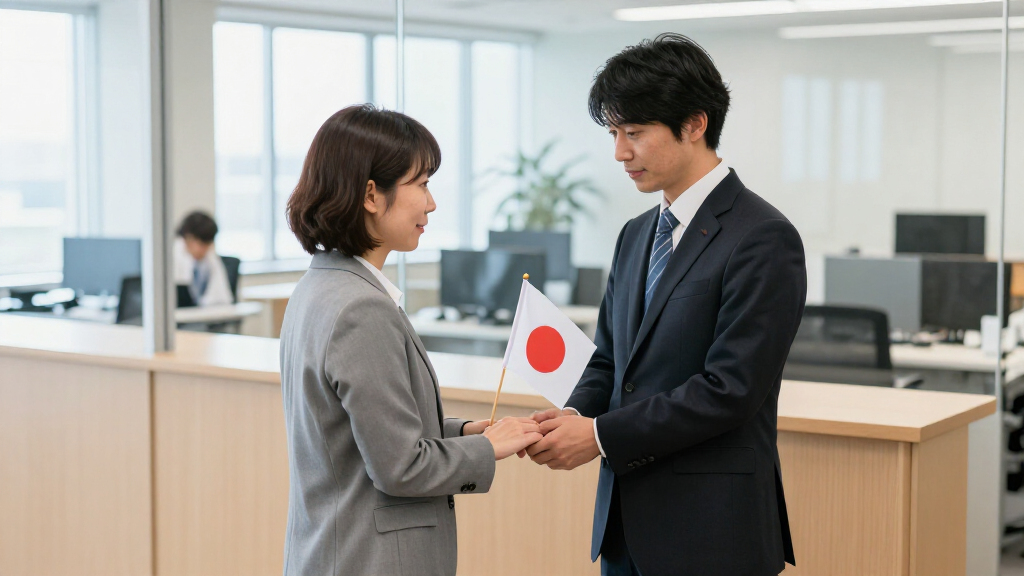

TL;DR

Turn your quiet moments into listening time
- Thousands of audiobooks, podcasts and originals
- Listen on your phone, tablet or Echo — also offline
- Cancel anytime
Derek Wessman’s blog report says he became a citizen of Japan after starting the naturalization process in 2012. He describes extensive documentation and cautions readers to seek guidance from their local Legal Affairs Bureau; the supplied excerpt does not state when his application was approved or provide official confirmation.
Derek Wessman says he became a citizen of Japan, according to a personal report on his blog describing the naturalization process he began in 2012. His account offers a first-person view of the paperwork and consultations he encountered, but the available excerpt does not specify when his application was approved or include independent confirmation of his status.
Wessman writes that he had considered naturalizing for a long time before visiting the Legal Affairs Bureau in 2012. He says he went there initially for another matter and then decided to ask about citizenship. A staff member accommodated an initial consultation, during which Wessman was asked about his nationality, years in Japan, marital status and family. He recalls being proud of his Japanese-language ability, community activity and work in Japanese politics, but says the official explained the process rather than treating those experiences as a guarantee of success.
The account describes a substantial collection of records. Wessman lists birth and marriage documents for himself and relatives, residence and work histories, educational records, tax and insurance payment records, and information about his household finances. He says English-language documents required Japanese translations, while Japanese documents needed originals and copies. He also describes records connected with his company, including financial statements and tax documentation.
Wessman characterizes naturalization as a long, document-intensive process with an outcome that can involve judgment. That is his assessment, not a quotation from an official policy document. In an editorial note, he says readers considering an application should consult their own Legal Affairs Bureau and follow its guidance rather than rely on online accounts. He emphasizes that cases are handled individually.
A Personal Account of Naturalization
Wessman’s report matters as a practical account of what one applicant says he experienced, particularly for foreign residents weighing whether to seek Japanese citizenship. The examples show that his preparation extended beyond identity papers to records about family relationships, residence history, finances, taxes and business activity. That breadth can help readers understand why an application may require sustained preparation.
At the same time, the post is not an official checklist or a statement of requirements applicable to every applicant. Wessman himself warns that documentation depends on the individual case and directs prospective applicants to the local Legal Affairs Bureau. Readers should treat his list as a description of his experience, not as legal advice or a current, complete account of the rules.
Products Worth Considering

Garmin Forerunner 265S 42 mm GPS Running Watch, Light Pink and Powder Gray

Levoit Core 400S-P Smart Air Purifier for Large Rooms

Coway Airmega AP-1512HHS Smart Air Purifier, Black
As an affiliate, we earn on qualifying purchases.
The Process Began in 2012
Wessman says his first naturalization consultation took place in 2012 at the Legal Affairs Bureau serving Hachioji. He recalls that the office was then in Minami Osawa, away from the town center, and writes that it has since moved back near the courthouse. This office-location detail is part of his personal timeline; the excerpt does not give dates for the later stages of his application.
His post combines anecdote, opinion and factual description, and he explicitly tells readers that he is not separating those categories sentence by sentence. He also says that more people were applying by the time of his update than when he first visited, but offers no figures or comparison period. The account therefore should not be read as a statistical description of application trends.
“I became a citizen of Japan.”
— Derek Wessman, in his blog post
Approval Date and Official Record
The supplied report excerpt does not state when Wessman’s citizenship was granted, how long his own application took, or which documents were ultimately required in his case. It also does not include an approval notice or confirmation from Japanese authorities. The blog’s title and opening sentence report his citizenship, but the source material available here supports that as Wessman’s statement.
His document list is presented from memory and includes qualifications such as uncertain time ranges. The excerpt ends while he is describing passport records, so it does not establish that the list is complete. It is also unclear whether the procedures he recounts remain current. Wessman advises applicants to verify requirements directly with the relevant bureau.
Applicants Should Check Locally
Wessman’s stated next step for readers considering naturalization is to consult the Legal Affairs Bureau in their area and follow the instructions given for their circumstances. The post does not announce a further official review, a policy change or a scheduled development related to his case.
For a fuller account of his own outcome, readers would need information beyond the supplied excerpt, including the date of approval and any additional details Wessman may have published. Until those details are available, his post is best understood as a personal report of a process that began in 2012.
Key Questions
Who says they became a citizen of Japan?
Derek Wessman says in a post on his blog that he became a Japanese citizen. The supplied material is his personal report, not an official government record.
When did Wessman begin the naturalization process?
He writes that he first approached the Legal Affairs Bureau about naturalization in 2012. The excerpt does not say when his citizenship was granted.
What kinds of records did he describe collecting?
His list includes identity and family documents, residence, education and work histories, tax and insurance records, household financial information, and business records. He says requirements are individual and the list should not be treated as a universal checklist.
Does the post provide current official application requirements?
No. Wessman urges prospective applicants to consult their local Legal Affairs Bureau for case-specific instructions. The excerpt does not establish whether every detail he recalls remains current.
Source: hn