
Religion provides a structured system with doctrines, rituals, and community practices that guide your beliefs and behaviors. Spirituality, on the other hand, is more personal and flexible, focusing on your inner growth and connection with the divine or universe through individual experiences. If you’re curious about how these paths differ in practice and focus, exploring further can help you understand which approach aligns best with your journey.

Turn your quiet moments into listening time
- Thousands of audiobooks, podcasts and originals
- Listen on your phone, tablet or Echo — also offline
- Cancel anytime
Key Takeaways
- Religion involves organized doctrines, rituals, and community practices, while spirituality emphasizes personal beliefs and individual experiences.
- Religious practices follow established norms and traditions; spirituality allows flexible, self-directed exploration of inner growth.
- Religion provides a shared framework and collective identity; spirituality focuses on personal connection and inner peace.
- External expressions like rituals and commandments are central in religion; spirituality emphasizes inner reflection, meditation, and personal discovery.
- Religion tends to be structured and institutional; spirituality is fluid, adaptable, and evolves with individual beliefs.
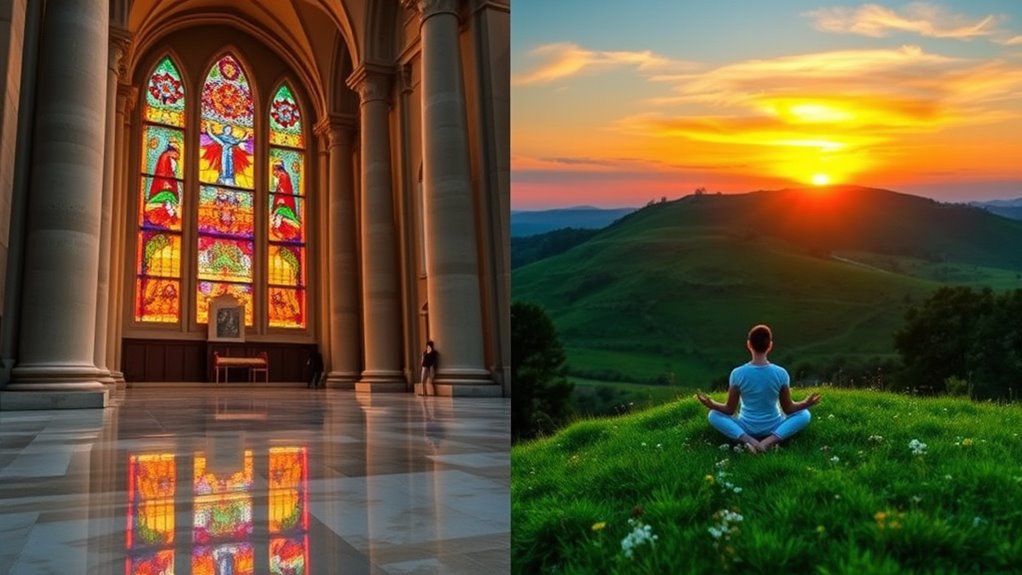
Have you ever wondered what truly distinguishes faith from spirituality? At first glance, they might seem similar, but when you dig deeper, you’ll find clear differences. Religion often involves organized systems, with set doctrines, rituals, and community practices. It provides a structured way to connect with a higher power or divine force, usually through faith practices that are shared among followers. These faith practices—like attending services, praying at specific times, or following religious laws—serve as outward expressions of devotion and belief. They create a sense of belonging and shared identity, reinforcing the collective nature of religious life. Personal beliefs, in this context, are often shaped by religious teachings, scriptures, and traditions. You might accept certain doctrines because they are part of a faith community, or because you’ve been raised within that religious framework. Religion tends to emphasize adherence to established norms, which can sometimes lead to a more externalized approach to spirituality—focused on rituals and commandments rather than personal exploration. Additionally, the use of organized structures helps followers maintain consistency in their practices and beliefs. Spirituality, on the other hand, is more fluid and individualized. It isn’t necessarily tied to a particular organization or doctrine. Instead, it revolves around your personal beliefs and experiences, emphasizing inner growth, self-awareness, and a direct connection with the divine or the universe. When you explore spirituality, you’re often seeking meaning beyond what’s prescribed by organized religion. It allows you to develop your own faith practices—whether that’s meditation, journaling, or simply spending time in nature—based on what resonates with your inner truth. Personal beliefs in spirituality tend to be more flexible, evolving as you grow and learn. You might not follow specific rituals, but instead find your own ways to nurture your sense of connection and purpose. This focus on personal experience means that spirituality can be more inclusive and adaptable, accommodating diverse perspectives and paths. While religion offers a shared framework built around faith practices and collective beliefs, spirituality invites you to forge your own path, grounded in personal beliefs and inner experiences. Both can provide meaningful ways to explore your relationship with the divine or the universe, but they approach this quest differently. Religion provides structure, community, and tradition, often serving as a guiding map. Spirituality, meanwhile, emphasizes personal discovery, inner peace, and the freedom to define your own spiritual journey. Recognizing these distinctions helps you understand what resonates most with you as you seek connection and meaning in your life.
meditation and mindfulness books
As an affiliate, we earn on qualifying purchases.
As an affiliate, we earn on qualifying purchases.
Frequently Asked Questions
How Do Personal Beliefs Influence Religious and Spiritual Practices?
Your personal belief systems shape how you engage with both religious and spiritual practices. They influence your faith development by guiding what rituals, prayers, or meditation techniques resonate with you. When your beliefs are strong, you’re more likely to seek meaningful experiences and deepen your connection to your faith or spirituality. Ultimately, your beliefs act as a foundation, directing your practices and helping you find purpose in your spiritual journey.
Can Someone Identify as Both Religious and Spiritual Simultaneously?
Yes, you can definitely identify as both religious and spiritual simultaneously. Many people embrace dual identities by holding overlapping beliefs, practicing religious rituals, and exploring personal spirituality. This allows you to deepen your connection to faith while nurturing your inner growth. By blending these aspects, you create a richer, more meaningful spiritual journey. Embracing both helps you find balance, purpose, and a broader understanding of your spiritual life.
What Role Does Community Play in Spirituality Versus Religion?
Community plays a essential role in both spirituality and religion, offering support and connection. In religion, shared rituals and organized gatherings foster a sense of belonging and collective identity. In spirituality, community support might be less formal, often centered around like-minded individuals who inspire and encourage your personal growth. Both aspects enhance your journey, whether through structured practices or heartfelt connections, helping you feel less alone in your pursuit of meaning.
How Do Religions Adapt to Modern Societal Changes?
You might notice that religions adapt to modern societal changes by embracing secularization trends and technological influence. They update rituals, utilize social media, and offer online communities to stay relevant. This exemplifies that faith often evolves to meet contemporary needs, making spirituality more accessible. By doing so, religions maintain their relevance, foster connection, and continue guiding followers amid rapid societal shifts.
Are There Universal Spiritual Truths Across Different Faiths?
You might find that universal spiritual truths exist across different faiths, like compassion, love, and interconnectedness. These principles often transcend specific doctrines, uniting diverse spiritual traditions. Embracing spiritual diversity helps you see that while beliefs vary, many share core values. Recognizing these universal principles fosters understanding and respect, showing that amidst differences, common spiritual truths can inspire kindness, peace, and unity across all paths.
religious prayer and ritual supplies
As an affiliate, we earn on qualifying purchases.
As an affiliate, we earn on qualifying purchases.
Conclusion
Understanding the difference between religion and spirituality helps you find what truly resonates with you. While 84% of people worldwide identify with a religion, many also explore personal spiritual practices outside organized beliefs. Remember, whether you follow a structured faith or seek inner growth on your own, both paths aim to bring meaning and connection to your life. Embrace what feels authentic, and trust that your journey is uniquely yours.
As an affiliate, we earn on qualifying purchases.
spirituality and meditation accessories
As an affiliate, we earn on qualifying purchases.
As an affiliate, we earn on qualifying purchases.
Evergreen bestsellers Picks
bestsellers
As an affiliate, we earn on qualifying purchases.